

Civil Society and Community Response, submitted on Oct 1 2026, to the Call for Comments and Notice of a Public Hearing: Review of the Environmental and Social Impact Assessment Report for the Proposed Extension of Tailings Storage Facility (TD15G) in Chambishi of Kalulushi District published on September 18, 2026.
Introduction
We — representatives of the Kitwe District Land Alliance, Kalusale Community Board, FIAN Zambia, and Civil Society Tailings Working Group—respectfully raise concerns and requests below in response to the recent proposal to expand the existing Tailings Storage Facility (TD15G) owned and operated by Sino-Metals Leach Zambia Limited (SMLZ) and the public hearing that took place on 23 September, 2026 in Chambishi, Kalulushi District. We emphasize that the following concerns are particularly pressing in light of the 18 February, 2025 tailings dam failure at the same facility, which released over 50 million litres of acidic efflcient into the Mwambishi River and which is the subject of multiple ongoing litigations.
Procedural Concerns
Insufficient Time to Respond
a. As outlined in 7. (1) of the Environmental Management (EIA) Regulations, Statutory Instrument No. 3 of 2026, referenced in the 18 September call for comments, ZEMA is required to circulate environmental and social impact assessments (ESIAs) to the general public. Persons are allowed to submit comments within 10 days of the last notification issued by ZEMA. This time period is minimal and unjust. It provides a seriously short window for communities to review complex technical
documents and provide meaningful input, and constitutes a structural defi ciency, not merely a practical inconvenience.
b. The time to respond to an extension presupposes that, before this proposal to extend, the communities neighboring the mine provided Free, Prior and Informed Consent. Our information is that this is not the case.
c. We request that these time frames be amended to enable full and effective participation of impacted and affected individuals and communities.
Failing to provide conditions for the Full and Informed Participation of Communities and Individuals
We believe that, in line with the CSOs endorsed “Safety First Guidelines for Responsible Mine Tailings Management” and best practices in internationally recognized ESIAs norms and standards:
i. Physical and/or digital notices advertising or inviting people to attend hearings, and the proposal itself, must be in the indigenous languages of the people in the affected area. The proposed ESIAs report didn’t provide the version in Bemba.
ii. Communities must be given access, at company expense, to experts who will capacitate community leaders and the community at large to participate from an informed basis and to have the tools to provide consent, if they agree to the proposals.
We request reasonable time to address these concerns, implement corrective measures and allow communities and impacted individuals to exercise their right to meaningfully participate in decision-making whose consequences they will live with for most of their lives.
We request that all parties who signed on to this communication, as well as the Zambia Human Rights Commission, be informed of any developments related to the proposal.
We request an extension of at least 90 days to allow for meaningful consultation, including all the above proposals.
We find it to be INCONSISTENT to allow Sino-Metals the right of extension considering that:
a. There are environmental issues that have not been resolved since the last spillage.
b. Peasant farmers and Kalusale residents have not been compensated adequately.
Technical Concerns
The Environmental and Social Impact Statement for the Proposed Extension of Tailings Storage Facility (TD15G-1) by Sino-Metals Leach Zambia Limited in Chambishi, Kalulushi District, Copperbelt Province—hereinafter referred to as “the ESIA”—omits critical information and contains proposals misaligned with tailings best practices.
No mention of the previous tailings dam failure; no mention of harms to communities and ongoing lawsuits; no sufficient compensation has been given to affected communities
The ESIA does not reference the previous tailings dam failure at the site, which occurred on Feb 28, 2025 and has caused severe pollution and impact on communities. Because the company is applying to expand its tailings dam at the failure site, it is reasonable to expect the company to acknowledge failures in the design, construction, maintenance and oversight of the previous TSF and address those issues in the ESIA to ensure it does not repeat those mistakes in the future. Not only does the ESIA not reference the failure, but section 1.11 Track Record (p. 9) of the ESIA does not reference the prior failure at all and states:
“The company has experience in managing TSFs and metallurgical operations; a record of complying with ZEMA requirements for EIAs/EPBs; and a corporate responsibility program focused on community support and environmental compliance.”
Sino-Metals Leach Ltd, the owner of TD15G is not in line with the international good practices of tailings management and did not disclose the facts of the previous tailings dam failure that caused severe impact on the communities and environment.
Lack of information regarding intended design, construction, and monitoring required by the GISTM
The ESIA contains provisions and information that do not conform to key requirements of the Global Industry Standard for Tailings Management (GISTM), which is recognized as the foremost international best practices framework. The ESIA itself claims it will ensure monitoring compliance with Zambian statutory requirements and international best practices, including the GISTM, but does not include any information on the following dam safety criteria as outlined in the GISTM:
a. Requirement 1.1: “….conduct human rights due diligence to inform management decisions throughout the tailings facility lifecycle and address the human rights risks of tailings facility credible failure scenarios.” [emphasis added]
b. Requirement 2.2: “Prepare, document and update a detailed site characterisation of the tailings facility site(s) that includes data on climate, geomorphology, geology, geochemistry, hydrology and hydrogeology (surface and groundwater fl ow and quality), geotechnical, and seismicity. The physical and chemical properties of the tailings shall be characterised and updated regularly to account for variability in ore properties and processing.”
c. Requirement 2.3: Develop and document a breach analysis for the tailings facility using a methodology that considers credible failure modes, site conditions, and the properties of the slurry. The results of the analysis shall estimate the physical area impacted by a potential failure. When fl owable materials (water and liquefi able solids) are present at tailings facilities with Consequence Classifi cation of ‘High’, ‘Very High’ or ‘Extreme’, the results should include estimates of the physical area impacted by a potential failure, fl ow arrival times, depth and velocities, and depth of material deposition. Update whenever there is a material change either to the tailings facility or the physical area impacted. (p. 08)
d. Requirement 2.4: In order to identify the groups most at risk, refer to the updated tailings facility breach analysis to assess and document
potential human exposure and vulnerability to tailings facility credible failure scenarios. Update the assessment whenever there is a material change either to the tailings facility or to the knowledge base. (p. 08)
e. Requirement 3.2: For new tailings facilities, the Operator shall use the knowledge base and undertake a multi-criteria alternatives analysis of all feasible sites, technologies and strategies for tailings management. The goal of this analysis shall be to: (i) select an alternative that minimises risks to people and the environment throughout the tailings facility lifecycle; and (ii) minimise the volume of tailings and water placed in external tailings facilities. This analysis shall be reviewed by the Independent Tailings Review Board (ITRB) or a senior independent technical reviewer. For existing tailings facilities, the Operator shall periodically review and refi ne the tailings technologies and design, and management strategies to minimise risk and improve environmental outcomes. An exception applies to facilities that are demonstrated to be in a state of safe closure
f. Requirement 3.3: “For new tailings facilities, use the knowledge base, including uncertainties due to climate change, to assess the social, environmental and local economic impacts of the tailings facility and its potential failure throughout its lifecycle. Where impact assessments predict material acute or chronic impacts, the Operator shall develop, document and implement impact mitigation and management plans using the mitigation hierarchy.”
g. Requirement 4.1: Determine the consequence of failure classifi cation of the tailings facility by assessing the downstream conditions documented in the knowledge base and selecting the classifi cation corresponding to the highest Consequence Classifi cation for each category in Annex 2, Table 1. The assessment and selection of the classifi cation shall be based on credible failure modes, and shall be defensible and documented.
h. Requirement 4.5: Apply design criteria, such as factors of safety for slope stability and seepage management, that consider estimated operational properties of materials and expected performance of design elements, and quality of the implementation of risk management systems. These issues should also be appropriately accounted for in designs based on deformation analyses.
i. Requirement 4.8: The EOR [Engineer of Record] shall prepare a Design Basis Report (DBR) that details the design assumptions and criteria, including operating constraints, and that provides the basis for the design of all phases of the tailings facility lifecycle. The DBR shall be reviewed by the ITRB or senior independent technical reviewer. The EOR shall update the DBR every time there is a material change in the design assumptions, design criteria, design or the knowledge base and confi rm internal consistency among these elements.
j. Requirement 5.3: Develop, implement and maintain a water balance model and associated water management plans for the tailings facility, taking into account the knowledge base including climate change, upstream and downstream hydrological and hydrogeological basins, the mine site, mine planning and overall operations and the integrity of the tailings facility throughout its lifecycle. The water management programme must be designed to protect against unintentional releases.
No reference to relevant Chinese higher standards
The ESIA states “Sino-Metals Leach Zambia Limited (SMLZ) is… a subsidiary of China Nonferrous Metal Mining (Group) Co., Ltd. (CNMC).” CNMC is a Chinese central government-owned enterprise and is supposed to comply with a Chinese government-issued normative document, Opinions on Promoting the Green Development of the Belt and Road Initiative (<国家发展改革委等部门关于推进共建“一带一路”绿色发展的意见>2022). Article 13 requires Chinese companies to implement environmental protection with reference to international common standards or higher Chinese standards when operating abroad. China’s Ecological and Environmental Code (2026), Opinions on Further Strengthening the Prevention and Control of Heavy Metal Pollution (MEE 2022), Mining Resources Management Law (2025), and the Implementation Regulations of the Mineral Resources Law (2026) all set strict standards for heavy metal pollution prevention and control,
rehabilitating requirements for mining sites and tailings dams. The ESIAs does not refer to Chinese laws and standards that SMLZ, a subsidiary of a Chinese state-owned company (CNMC) is required to comply with and does not provide the heavy metal pollution monitoring and clean up plan.
Tailings delivery system is not aligned with best practices
On Pages i of the ESIA, it is stated that:
“Tailings from the existing leaching plant will be pumped via a dedicated HDPE pipeline (approximately 0.225 m diameter) to the proposed combined Tailings Storage Facility TD15G-1 (existing Pond G plus western extension). The slurry will be discharged at a solids content of approximately 50%, which is thick enough to minimise free water yet suffi ciently fl uid for reliable pumping without settling. The pipeline will be supported on concrete piers as required, with manual shut-off valves, and inspected daily. This method eliminates road transport of tailings, avoiding traffi c disruptions, road damage, and spillage risks.”
The proposed method of delivery, as a slurry with a solids content of approximately 50%, does not conform with international best practices which recommend dry stack or fi ltered tailings as the safest method of delivery. If the company has assessed using the dry stack method and opted to proceed with slurry storage, the assessment and reasoning behind this decision should be included in the ESIA.
There are also inconsistencies in the information presented on the solids content of the tailings. Pages i, 1, 22 and 25 state the solids content will be approximately 50%, while on Page 62, it says the solids content will be 75%.
Issues with the proposed lining system
On Page ii of the ESIA, it is stated that: “The entire pond area (both existing Pond G and the western extension) will be equipped with a 1.5 mm thick HDPE composite geomembrane anti-seepage layer. The geomembrane will be laid over the prepared subgrade and anchored at the dam crest and the 1330 m inner slope platform. The existing geomembrane from the demolished emergency pools may be reused after quality inspection. This single-layer HDPE system effectively prevents seepage of tailings liquor into the foundation, protecting underlying groundwater.”
The proposal to lay the geomembrane over the prepared subgrade obfuscates the fact that the “prepared subgrade” refers to existing tailings. Effectively, the proposal is to place the lining directly on top of existing tailings. International best practices establish a dual layer system, whereby the geomembrane is laid over another layer of usually clay or bentonite, as the safest choice as the geomembrane can be prone to wear, allowing seepage of tailings into groundwater.
Maximum potential rainfall is not accounted for
The ESIA provides data on mean annual rainfall and maximum monthly rainfall (p.30). However, overall maximum potential rainfall is not indicated. Maximum potential rainfall is necessary to calculate so storage capacity can be designed to hold the potential water.
Issues with dam construction methods
Appendix 10 (p. 113) displays the proposed design of TD15G-1. However, the text is too small and distorted to read and understand. The proposed design appears to include three raises to the dam, however, there are no details anywhere in the ESIA as to how those raises will be constructed (upstream, downstream, centerline). It has been demonstrated that upstream dams have a higher likelihood of failure. If the upstream method is to be used, the ESIA should defi ne the risk associated with the design. Page 5 says “The fl at-type design with dams built at one time is consistent with existing Pond G, operationally simple, and cost-effective.” That seems to imply a single raise for the dam embankment. If so, that appears to contradict the design presented in Appendix 10.
The slope is designed at a ratio of inner slope- 1:2.5; outer slope -1:2.5; and south dam-1:3.0. The slope of the outer embankment of the tailings dam must be low enough to keep the annual probability of failure due to piping (also called internal erosion) below an acceptable level. Guidance from the US Army Corps of Engineers (U.S. Army Corps of Engineers (USACE), 2000. Design and construction of levees: Manual No. 1110-2-1913. 164 p.) requires outer embankments to be constructed with slopes 1V:5H or less. The proposed slope is much steeper.
No calculation of failure and compounded failure
The ESIA contains no calculation of the annual probability of failure. The annual probability of failure is a better indicator of the risk of failure than the factor of safety, which is also not provided but referenced on Pages ii, 2, and 22.
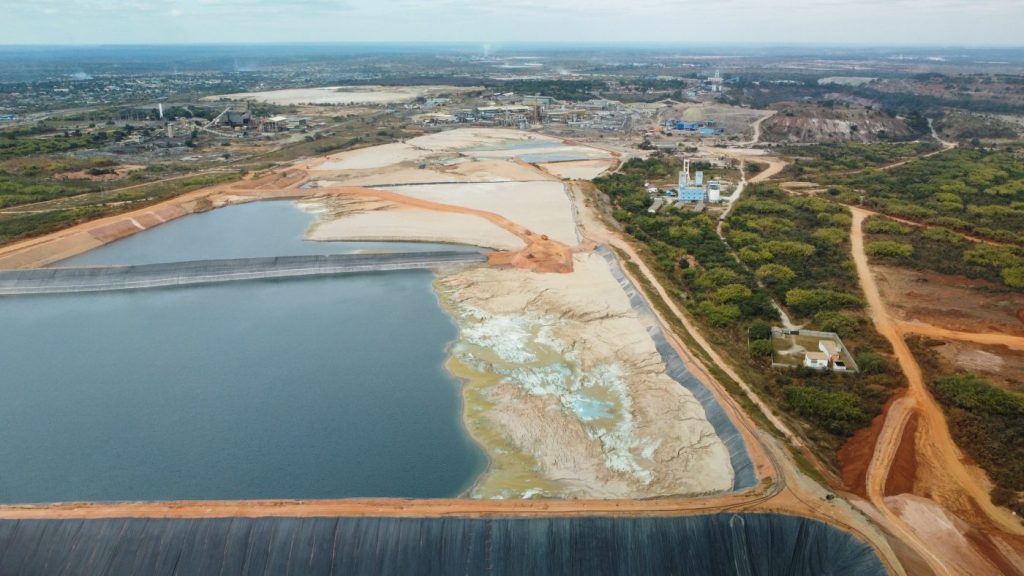
There is also no consideration of the potential for cascading failures between tailings dams nor of the cumulative impacts of multiple tailings dams in one site. Based on the photo in Appendix 9 (p. 112), it appears that TD15G-1 will be in addition to four active and two failed TSFs which all abut each other. However, there are no descriptions of these other TSFs anywhere in the ESIA. There is no analysis of the potential for TD15G-1 to fail into the existing TSFs, and what the consequences might be. Nor is there any analysis of the existing TSFs failing into the new TSF, and the potential consequences. A cascading failure is possible which could increase the potential impacts and distance of fl ow of a tailings failure.
Similarly, the ESIA contains no consideration of the cumulative impacts of dust, water contamination, impacts on soil of multiple dams at one site. For example, the ESIA states that during construction of TD15G-1, there is a “Probable” likelihood that “Moderate” levels of dust will be discharged “Daily” and have a “Medium” impact. There are no calculations that accommodate for the likely change and probable increase in dust levels from TD15G-1 when combined with dust releases from the existing TSFs. As well, the Environmental and Social Management Plan (Section 10) does not include any analysis of the impacts or mitigation measures for a tailings failure.
Limited geographical information
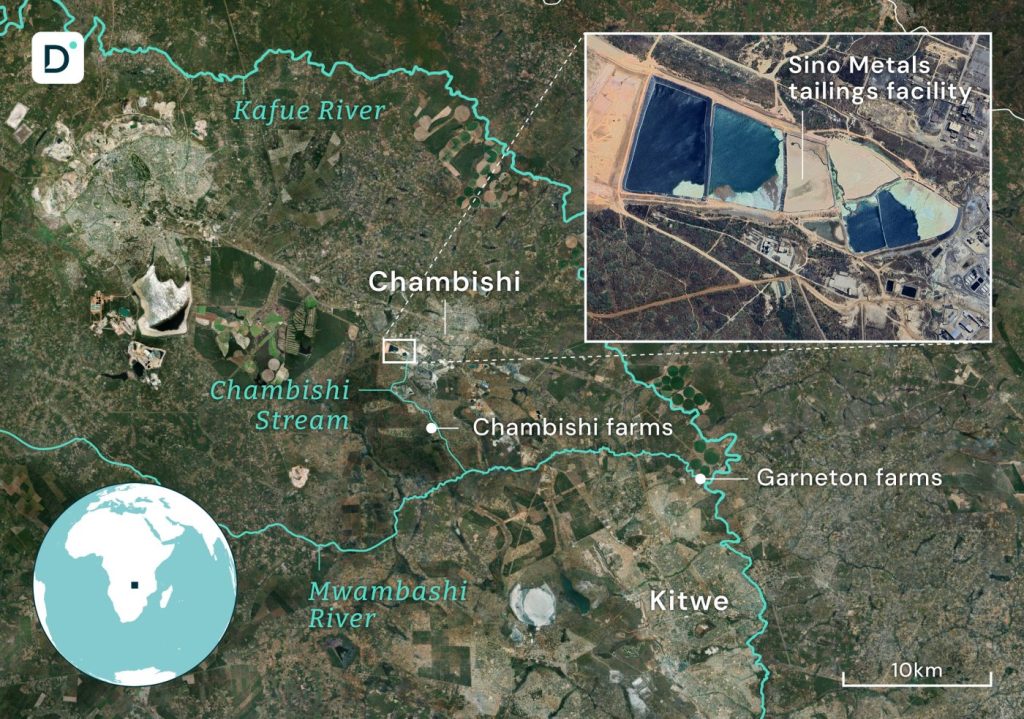
There are no maps, photos, or diagrams that show the location of TD15G-1 in relation to waterways, mining infrastructure where workers may be present, or local communities. This makes it challenging to understand how chronic seepage, or a structural failure of a tailings dam may impact the surrounding environment, workers, and communities.
On Pages iii, xi, 8, 21, and 34 of the ESIA, it says that “Other nearby landmarks include the Chingola-Kitwe Road located about 500m, Eco Petroleum Filling Station located about 2.12Km North East of the project site, Cosak Substation CEC located about 1.95Km North East of the proposed project site, Chambishi Metals located about 1.39Km east of the proposed project site, and JCHX Mining Limited located about
3.21Km South East of the proposed project site.” However, there is no context given on how TD15G-1 may or may not impact these landmarks and areas. It is not explained whether any would be in the fl ow path of a potential failure. If any were in the potential path, it is also unclear how long it would take the tailings to arrive at the landmarks or areas.
On Pages ix and 32 of the ESIA, it says that “The nearest surface hydrological resources include Chambishi stream located about 7.65 km south of the proposed project site, and Lulamba stream located about 1.75 km north. The natural drainage course runs from north-west to south-east, leading to the Mwambashi River. Intermittent and ephemeral drainage courses around the project site drain into the Chambishi stream, which subsequently drains into the Mwambashi River near Sabina area.” No information is given on how a tailings failure would impact these rivers and whether they are in the fl ow path. On Pages xvii and 40 of the ESIA, it is stated that “Risk of sediment-laden runoff from exposed areas entering Chambishi stream (7.65 km south) or Lulamba stream (1.75 km north).” However, no further detail on these risks is provided.
Unclear evaluation of impacts
The Evaluation of Impacts (Section 8) does not include any criteria for how the evaluations were made. For example, the “Embankment stability failure (rolled earth-rock dam, engineered slopes, independent review)” (p. 51) is designated as “unlikely” but given a previous tailings failure at the site, it would be important to evaluate how such a designation was determined. Similarly, it is important to evaluate how the designations for air pollution, water contamination, soil contamination, etcetera were determined.
Undefined post-closure monitoring
The ESIA states that post-closure monitoring will be carried out by the company for at least 5 years after closure, but does not assume responsibility for indefi nite monitoring. Given the TSF will remain in perpetuity at the site, it is important to indicate who will assume responsibility for monitoring and maintenance after the 5-year period.
Deficiencies in emergency response planning
The Emergency Preparedness and Response Plan (12.5.5) (p. 83) does not include suffi cient details to assess whether it will appropriately respond to emergency scenarios. It also does not include communities in the design of the plan, nor in the proposed trainings and drills.
Further Recommendations
In addition to amending the ESIA to include the aforementioned information and abide by the requirements, the following steps should be taken:
Given the past failure of tailings facilities at the site, there should be an independent evaluation of all aspects of the design, construction, operation, and maintenance—including during closure and rehabilitation—of the TSF, by a group of competent, objective, third-party reviewers (an Independent Tailings Review Board). The ESIA mentions “An independent geotechnical engineer” (p ii; p.2; p.22), but the company should form an ITRB given the past tailings management failures at the site.


Leave a Reply