
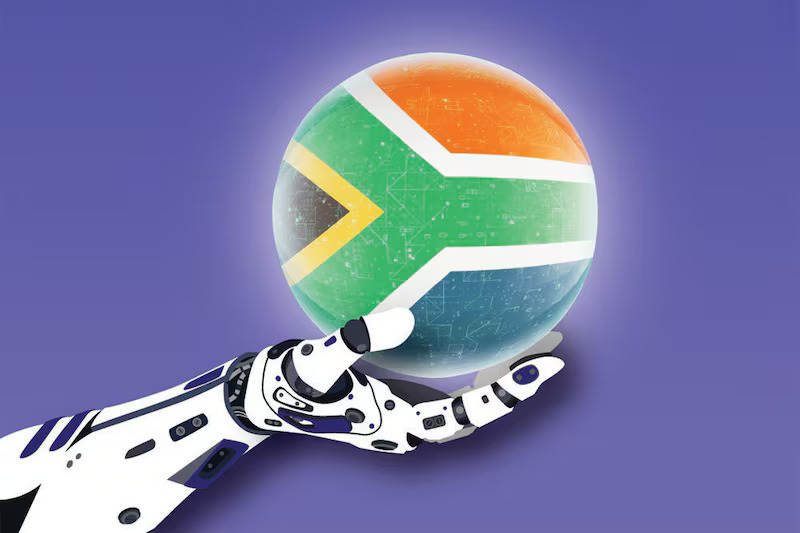
To: the Portfolio Committee on Communications and Digital Technologies and the Minister, Mr. Solly Malatsi. RE: National Artificial Intelligence Policy and the Need for Inclusive, Transparent Governance
25 May 2026: The Data Centres, Surveillance, Control Working Group, a loose group of activists, acknowledges the recent withdrawal of the draft AI Policy. At our recent hybrid workshop, held on 15 May 2026, the recording is also available here for your perusal: https://www.youtube.com/watch?v=PVzo4GYnSY4 — we discussed the blatant human rights and environmental gaps in the policy direction of the withdrawn draft.
The withdrawal of the flawed policy and the prompt action of the Minister to correct these serious oversights that caused the withdrawal make it imperative that we ask the renewed panel to consider our concerns. These include concerns about genuine public participation and inclusive governance.
For us, transparent, public, and participatory engagement is non-negotiable. The multi-dimensionality of artificial intelligence, spanning social, economic, environmental, legal, ethical, and epistemological domains, cannot be adequately addressed through closed-door or narrowly framed consultations. Any credible policy process must actively seek out and incorporate diverse, lived experiences and expert knowledge.
We have learned through public announcements that an advisory body has now been established, and whilst we acknowledge the appointment of the advisory panel of experts as a positive development, as it includes many respected experts in the field, we humbly submit that this is not enough.
It is our concerted view that the panel may be missing persons with the expertise that speaks for the majority of our people and our national priorities in our world today. We are all committed to uphold principles of data sovereignty and confirm that our national data is not for sale but must become a driver to address national interest. This must ensure that the insights and innovations generated remain under domestic control and serve public priorities of Africans in general and South Africans in particular.
To correct this deficit and ensure that the full scope of AI’s impacts is addressed, we formally propose that the advisory body be expanded without delay to include the following expert constituencies:
Gender activist / expert (to address algorithmic bias, gendered labour impacts, and differential surveillance harms);
- Children’s rights expert (to address known and emerging risks to minors, including data privacy, developmental impacts, and online harms);
Historian (to provide critical context on technological transitions, state surveillance precedents, and the erosion of civic memory); - Expert in Indigenous Knowledge Systems (IKS) (to ensure the protection, recognition, and ethical integration of Indigenous data sovereignty, traditional knowledge, and community protocols, which are frequently marginalised or appropriated in AI development);
- Environmental expert (noting the significant adverse impacts of data centres and AI infrastructure on water, energy, and e-waste, with compliance to NEMA [National Environmental Management Act] not yet in effect);
- Heritage expert (to safeguard intangible and built heritage, given that compliance with NHRA [National Heritage Resources Act] remains outstanding);
- International human rights law expert;
- International humanitarian law expert; and
- Expert in monitoring the ethics of automated weaponry systems (given the cross-border and conflict implications of autonomous technologies);
- National security expert (noting how AI will change national security and warfare and its attendant power, as we have seen in West Asia and Ukraine).
The inclusion of these voices is not an exhaustive list but rather a minimum threshold for intersectional representativity. The known concerns regarding children’s rights, environmental degradation, heritage erasure, the erasure of Indigenous knowledge systems, and the gendered and militarised dimensions of AI cannot be disaggregated from one another. They require a governance body that reflects that very interdependence.
We remain committed to constructive engagement and stand ready to participate in open, transparent, and genuinely participatory processes going forward. We urge the Department of Communications and Digital Technologies to seize this moment, not merely to correct a procedural error, but to set a new standard for democratic AI governance.
Ends.
For additional comment, contact one of the following:
Hassen Lorgat +27823626180
Elinor Sisulu +2784 402 4931
Tauriq Jenkins +2764 734 2569
Shamima Vawda +27 72 123 4155
*Related: AI principles to guide action
 CSOs 4 Tailings Justice
Leave a comment