
3rd Annual Tailings and Mine Waste Conference and Workshop
9 to 11 September 2026 | Johannesburg, South Africa

The Tailings Working Group was formally launched in January 2024 under the banner of CSOs 4 Tailings Justice. Our mission is to build democratic community power to confront the dangers of mine waste and tailings facilities. We address the deadly asymmetry of power between corporations, a fragmented state, and poor and working-class communities living next to these toxic legacies. This is the third year of organising the Tailings Workshop and Conference. In our inaugural year, we highlighted the persistent complaint—at least in South Africa—of the multiplicity of laws and policies that limit tailings dam governance that is fair to all people, in particular working people, the poor, plant and animal life, and the ecology at large. Tailings remain a danger for us, here and everywhere.
Since the inaugural CSO tailings justice conference (June 26–27, 2024), at least seven major global tailings dam failures have occurred (with this figure likely being an undercount due to underreporting).
Key failures in chronological order (latest to earliest):
- April 2026 – Kitwe, Zambia: Retired state dam (33C) breached, leaking heavy metals into the Chibuluma stream and destroying aquatic life.
- Feb 18, 2026 – Sulawesi, Indonesia: Extreme rain triggered a fatal landslide and structural failure at an HPAL nickel tailings site (IMIP QMB).
- Nov 23, 2025 – Luapula, Zambia: Mukabamo copper mine breach led to immediate regulatory suspension.
- Nov 2025 – Kolwezi, DRC: Kasulo cobalt tailings failure sent toxic slurry into urban residential areas.
- March 2025 – Chambishi, Zambia: Sino-Metals collapse released ~1.5 million tonnes of acidic waste into the Mwambashi/Kafue rivers, poisoning drinking water for ~500,000 people.
- June 24, 2024 – Yukon, Canada: Eagle Gold mine heap leach failure spilled cyanide-laden solution into salmon-bearing waterways (the same week as the conference).
- June 13, 2024 – Valparaíso, Chile: Peñablanca copper facility collapsed, washing slurry into the La Ligua River.
According to experts, more are likely to happen, but thinking openly together and acting collectively may mitigate the scourge of mine waste posed by tailings dams and facilities. As Earthworks has advised, we must do more, and that includes reducing demand for newly mined minerals—especially relevant in this rush for critical raw materials and the AI and data centre boom—which would also reduce waste. The safest way to manage tailings is to not create them in the first place.
The Tailings Regulatory Landscape
South Africa has an excessive number of laws governing tailings storage—including the Water Act, Minerals Act, Mine Health and Safety Act, various codes and guidelines, and the 2015 Mining Residue Regulations—but these rules are poorly coordinated. While they theoretically cover design, operation, environmental monitoring, closure plans, community engagement, and emergency response, meaningful public participation in shaping these regulations is severely lacking. Historically, meaningful reforms have only come after major disasters and public outrage, highlighting the urgent need for a simplified, inclusive, and democratic overhaul of the entire system.
We have examined how the failure to pin responsibility on any single governmental actor debilitates poor communities living adjacent to mines and tailings dams. This is exacerbated by the failure to obtain redress for the burning grievances of communities. The One Environmental System was supposed to address this—a point we will return to later.
The 2025 Workshop: Building on Lessons Learned
South Africa’s second annual tailings workshop (28–30 July 2025) was held at a hotel, with the first day taking place at the premises of the SAHRC. In 2025, we examined the Jagersfontein disaster (2022) as a catastrophe with roots in the re-mining of a diamond facility. The content was shaped primarily by two government documents: proposed MPRDA amendments and a new policy on critical raw materials.
The workshop argued that mining has historically enriched corporations while displacing and harming poor and working-class communities through environmental racism—a legacy that continues today with over 6,000 derelict mines and ongoing pollution. The proposed amendments still rely on failed “trickle-down” economics and offer communities only consultation, not real negotiation power or the right to say “no.” Meanwhile, the critical minerals strategy promotes recycling mine waste as a new opportunity, but communities fear this repeats past exploitation without delivering jobs or safety.
Let us state the universally known facts upfront:
Mine waste remains the biggest single environmental challenge for the industry and creates huge amounts of toxic and non-toxic waste that remains forever. These tailings dams remain a permanent scar on the face of the earth. We know that mining produces staggering volumes of waste—between 90% and 99% of all processed material ends up as discarded rock or tailings—while only a tiny fraction is actually recovered for use. Global mining produces 13 billion tons of tailings per year. By 2050, tailings and waste rock are expected to reach 2 trillion tons. Yet the tiny fraction that is actually recovered, its proponents argue, is essential to global technology, energy, and construction—regardless of the cost.
This narrative, however, ignores the fundamental reality based on the externalisation of costs and the privatisation of profits. Corporations externalise their true costs—environmental degradation, ecological harm, and the health and safety burdens placed on workers and vulnerable communities—while privatising the benefits. This remains a deeply problematic and unresolved dimension of mining’s role in modern society.
The workshop aimed to help affected communities analyse these documents, coordinate responses, and push for genuine democratic participation, independent oversight (such as an ombud), and real redress—especially given that the 2022 Jagersfontein disaster exposed how tailings dams can fall entirely outside mining regulation. The MPRDA amendments were supposed to address this.
Building an Accountable Democracy
This year’s conference and workshop does not come out of a vacuum and seeks to build on the concerns we have raised. We are trying to renew organisational building and solidarity in an environment of despondency and weakened organisations and movements in South Africa. The Safety First Guidelines serve as an intellectual and organisational building resource that seeks to engage owners of tailings dams, government and regulatory bodies, as well as to help strengthen the untapped resources of mine-impacted communities and individuals.
We are cognisant that the role of tailings dam owners must be challenged to abide by binding global standards and conventions, as well as South African law. We have also learnt about the role of professional bodies such as the Engineers of Record, and how they can be engaged to uphold safety standards.
We will present reports on our engagement with the Global Training Management Institute (GTMI), which seeks to oversee the implementation of and conformance with the Global Industry Standard on Tailings Management (GISTM). In addition, and closely related to it, is the Global Mining Legacy Fund, which proposes—under UN guidance—to build trust, finance the rehabilitation of derelict, ownerless, or abandoned mines, and strengthen closure rules. The Institute has at last come around to involving local communities in tailings management. They wrote:
“Building effective tailings management and preventing major catastrophes requires the industry to form genuine partnerships with Indigenous Peoples and local communities, to secure their Free, Prior, and Informed Consent (FPIC) for facility locations and management.”
It is the CSO-driven Safety First Guidelines that demand that this participation be real and effective, and also provide professional assistance for tailings-impacted communities.
Safety First demands effective and principled participation:
- Companies must ensure meaningful engagement, participation, and consent of affected communities over the entire life of the mine. This includes the Right of Communities to say NO to tailings facilities.
- Emergency preparedness and response plans must be prepared in advance with all potentially affected communities, downstream agricultural producers and businesses, mine workers, first responders, and relevant authorities. Plans must be based on worst-case failure scenarios.
Our Activities Over the Past Year
Since our last workshop-conference (2025), we have engaged the Department of Mineral Resources and Energy (DMRE), the Department of Water and Sanitation (DWS), and also the authors of the Jagersfontein disaster report. This was part of our efforts at literacy and organisation building. Other activities include:
- Facility Mapping: Using available data and community knowledge to map local tailings facilities.
- Toxic Tours: Visiting mine dumps and impacted areas to document health and environmental effects.
- Civic Organising: Revisiting history to find ways of stemming marginalisation, poverty, and inequality, and working with others.
- Literacy: Educating residents on the Bill of Rights and global safety standards.
The Jagersfontein Disaster
After months of campaigning for the report to be released, it was eventually made public and can be accessed here:
https://www.dws.gov.za/DSO/Documents/Jagersfontein%20Final%20Report.pdf
This activism is part of our Tailings Literacy Programme, which is central to building community power. After years of demanding the report be made public, we finally organised a webinar on 8 May 2026, featuring Professors S.W. Jacobsz and Luis A. Torres-Cruz. The workshop, aimed at educating communities on what we can learn from the disaster, was a success. The recording is available here:
https://www.youtube.com/watch?v=77BWRdlB8jY
We also engaged the Department of Water and Sanitation on its administration of systems of Water Use Licences and the Dam Register—with the aim of ascertaining the state and extent of tailings facilities reporting to the authorities and the public.
Challenges and Systemic Failures
The building of power demands that we consider the poverty, hunger, and marginalisation that our communities living around mines find themselves in. We must also deal with the legacies of poor and weak governance and regulation—to which we must now return. We need to keep engaging with the Mining Law amendments, as well as exploring how Water Use Licences can be expanded and made more transparent, thereby assisting us in keeping them accountable. The Dam Register is wholly inadequate – at least when it comes to regulating tailings dams compliance. This is largely due to the failure of the owners of the dams to register the dams as per requirements of law whilst the enforcement agencies are under-resourced and thus ineffective.
Critical Raw Materials and Artificial Intelligence
Working with other groups and activists, we were obliged to engage with Critical Raw Materials as well as the trend of Artificial Intelligence. Many wrongly believe that these do not have anything to do with extractivism that dispossesses people of their land, water, and electricity resources—they need to think again. Without addressing the software needs, the hardware to build AI data centres relies on high-performance chips (GPUs, TPUs) built from critical minerals (silicon, gallium, germanium) and rare earth elements for cooling and robotics. To assist us in thinking and strategies, we helped to form—with other groups—the Data Centres Working Group, as we recognise that the extractivism of minerals and the underplaying of waste management will be a significant issue.
The One Environmental System
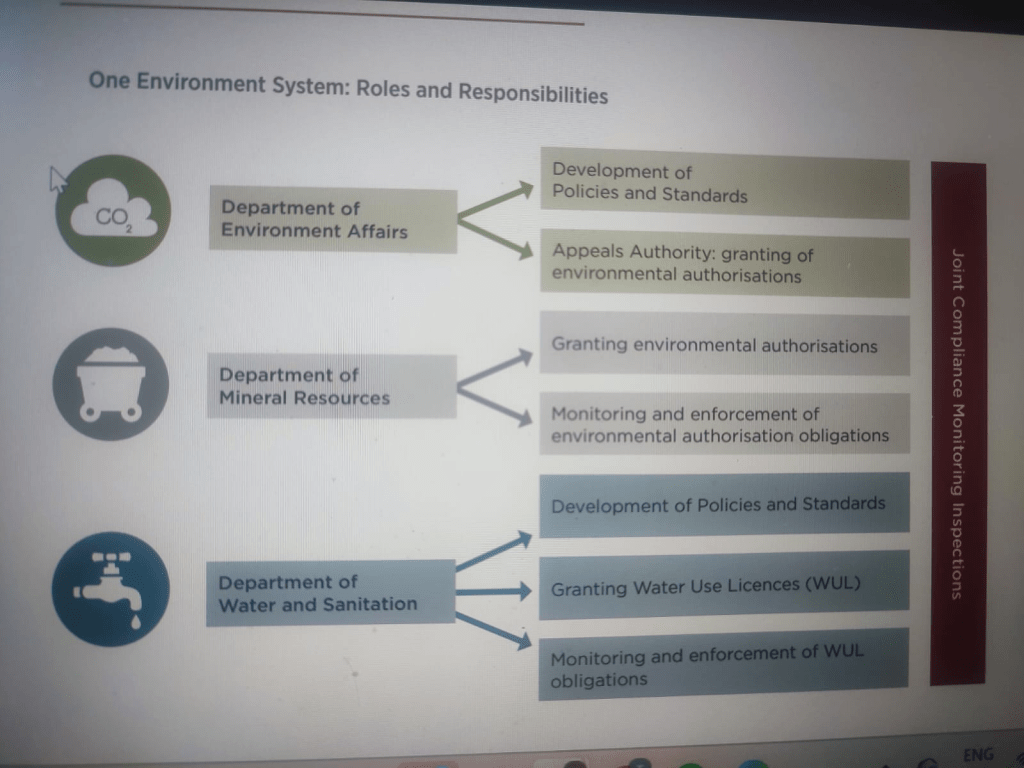
The One Environmental System (OES) was initiated on 8 December 2014, following the President’s State of the Nation Address. The government’s media release confirms that the OES was designed to integrate environmental management and licensing for the mining industry across key legislative frameworks. We believe it would be particularly useful in cases of mine closures, as well as in providing support for inter-departmental cooperation in tailings management long before disaster strikes.
Under the One Environmental System, the Minister of Mineral Resources will issue environmental authorisations and waste management licences in terms of the National Environmental Management Act, 1998 (Act No. 107 of 1998) [PDF] (NEMA), and the National Environmental Management: Waste Act, 2008 (Act No. 59 of 2008), respectively, for mining and related activities. The Minister of Environmental Affairs will be the appeal authority for these authorisations.
Interestingly, there was agreement on timeframes, as the Ministers of Environmental Affairs, Mineral Resources, and Water and Sanitation “have agreed on fixed time-frames for the consideration and issuing of the permits, licences and authorisations in their respective legislation.” In addition, they agreed to “synchronise the process for the issuing of permits, licences and authorisations within a 300-day period. In the event that a decision to issue a license is appealed, an additional maximum period of 90 days is provided for legislatively to finalise the process.” They revealed further:
- Timeframes: Until new laws are officially passed, the current timeframes in NEMA still apply.
- Inspectors: The Minister can appoint Environmental Mineral Resource Inspectors (EMRIs). They have the same powers as other environmental inspectors to enforce NEMA rules for mining activities.
- Regulations for Residue and Rehabilitation: New NEMA rules for mine residue and rehabilitation funding are not ready yet. Until they are, the old MPRDA regulations remain in effect.
Criticism of the One Environmental System
Leaving the mining department in charge remains controversial. The Centre for Environmental Rights has described the One Environmental System (OES) as letting the “minerals fox guard the environmental henhouse.” In addition, they argued that integrating environmental management into NEMA was flawed due to poor execution, legislative confusion, and a conflict of interest where mining authorities enforce environmental rules. All these criticisms are more acute now, as the disorganisation and lack of coordination persist—some 11 years later.
The South African Human Rights Commission (SAHRC) reviewed this framework in relation to the rights of mining-affected communities (2019) and reiterated concerns about conflicts of interest, as the DMRE—mandated to promote mining—may face inherent conflicts when simultaneously tasked with enforcing environmental authorisations and compliance. Despite the OES intending to streamline processes, the evidence given to the Commission reveals ongoing environmental degradation, poor air and water quality, inadequate concurrent rehabilitation in mining regions, and a lack of genuine consultations with affected communities.
The SAHRC expressed concerns about transparency and accountability shortcomings: “Fragmented oversight and opaque processes leave vulnerable communities exposed to health risks and economic displacement without clear redress measures that are community-friendly in place.” The full report is available at:
https://www.sahrc.org.za/home/21/files/SAHRC%20Mining%20communities%20report%20FINAL.pdf
The Way Forward and Call to Action
The rush to mine critical raw materials for AI and data centres continues to overlook ongoing violations of land rights and community ownership. There remains insufficient recognition that existing waste—particularly toxic tailings dams—must be addressed before new mining projects can proceed. The exact number of tailings dams and facilities remains unknown, both in South Africa and globally, where estimates suggest there are more than 100,000. This lack of precise data must be confronted and will form part of the discussions among conference-workshop attendees.
Participants are invited to learn and share, as we collectively embark on a journey of mutual education and knowledge exchange. It is an opportunity for us to revitalise our organisations and connect from below so that we can grow again into powerful mass movements of our times.
Join us. Build with us. Safety First – Together and from Below.
Written by Hassen Lorgat: Convener, CSO’s Tailings Working Group
 CSOs 4 Tailings Justice
Leave a comment