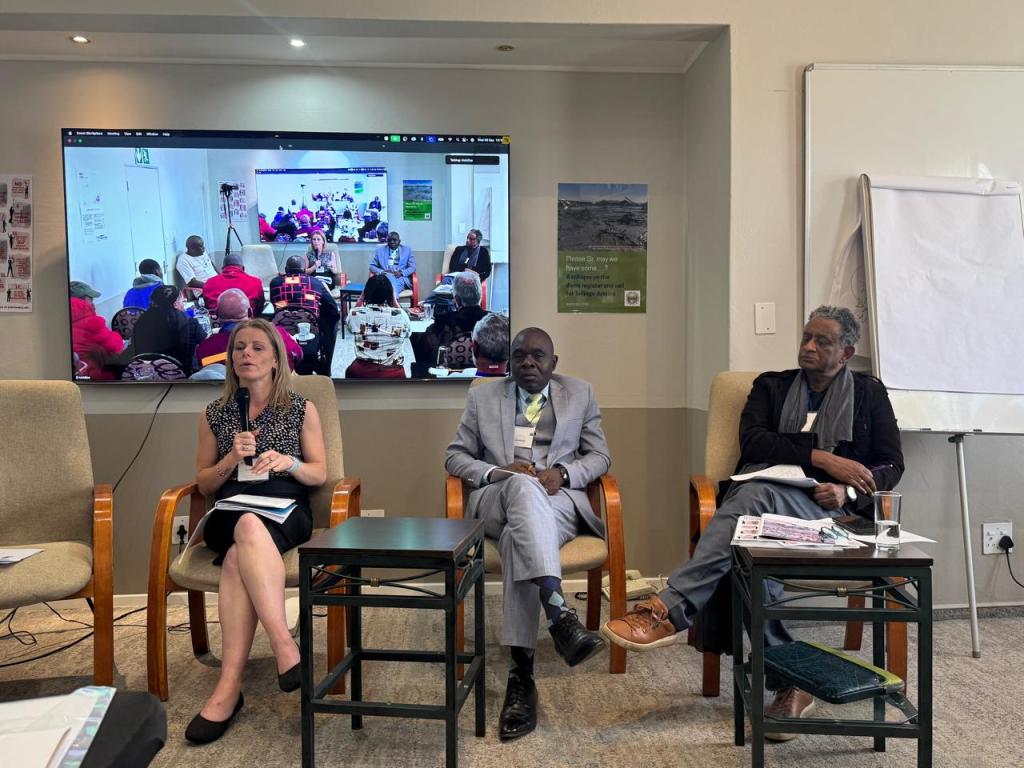
Conference presentation by Thabo Moramotse (Far West Rand Artisanal Miners association)
Opening.
My name is Thabo Moramotse, from the Far West Rand Artisanal miners association. Our members and operations are predominantly based in the Far West Rand, we are organised artisanal miners, we are an association of artisanal miners and our members have registered cooperatives and they are ready to go.
Our association affiliates with the National association of artisanal miners (NAAM), being like-minded organisations, at the centre of artisanal mining formalization we recognize that NAAM plays an important role in advocating for the rights of artisanal miners, particularly in light of the Mineral resources development amendment Bill (MRDB), which opens for an opportunity for formalization of the sector. As a result of the affiliation we are part of the national action plan (NAP) on mercury use reduction to full eradication in the Artisanal and small-scale gold mining (ASGM) sector, as per the minamata convention.
For decades communities like ours across South Africa’s mining belts have lived with the environmental, social, and economic consequences of mining, while many of our people seeking to recover value from these mining legacies are treated as nothing but criminals.
To us this is a serious contradiction; communities are expected to live with abandoned mine dumps, toxic tailings dams, polluted land and water, yet when local people attempt to recover the remaining minerals and remnants from these deposits, they are met with criminalization rather than meaningful pathways to formalization. We welcome the fact that South Africa is finally moving towards recognising artisanal and small-scale mining as a sector that needs regulation. But recognition on paper is not the same as formalisation in practice.
The situation on the ground is always a danger zone, as Artisanal miners are often treated as one category which is, “illegal miners” or “Zama Zamas”.
But there is a major difference between:
Organised artisanal miners trying to make a living;
● These are people working informally because they have no legal pathway.
Organised criminal syndicates;
● The people controlling illegal gold markets and violent criminal networks.
The law needs to distinguish these groups.
The NAP says enforcement should target non-compliant operators, illegal mercury traders, syndicates, kingpins and illegal processors, while warning that enforcement must not push survivalist and organised miners further underground, where they will always be illegal just by virtue of being there.
THE ASGM NAP
The Nap report recognises that ASGM is largely informal because miners lack;
● Accessible licensing regime,
● Equipment, and finance,
● Technical support, and safe processing facilities (whereby mercury use is eradicated),
● Formal markets, and realistic regulatory pathways. It specifically recommends simplified regulation.
The NAP proposes the following:
● Shorter application forms;
● Reduced fees;
● Shorter processing times;
● Standardised environmental templates;
● Proportionate requirements;
● Simplified compliance tools;
● Plain-language permit guides.
It even proposes consideration of a hybrid licensing model combining a simplified artisanal mining permit with a light environmental permit or code of practice.
Our challenge to government:
● “If the government agrees with its own ASGM NAP, then the question is simple: where is the practical pathway that allows an organised artisanal miner to become legal?”
THE MPRDA AMENDMENTS/GMLAB 2026
The Draft Mineral Resources Development Bill (MRD Bill) and the General Mining Laws Amendment Bill, 2026 (GMLAB) present a key tension between formalizing traditional livelihoods for our people and applying harsh criminal enforcement to the informal mining sector.
The problem here is the sequencing, (The cart before the horses scenario).
● Permit access vs Broad Criminalization:
The MRD Bill introduces a developmental framework intended to legalize and issue permits for artisanal mining, on the other hand the General Mining Laws Amendment Bill casts a wide enforcement net by criminalizing any individual or entity that indirectly or directly assists, facilitates, or provides services enabling illegal mining.
Moreover, the MRD Bill has its own gaps as well. Yes, we welcome the recognition of artisanal mining by the Bill, for the first time artisanal miners are acknowledged in South African law. But the Bill gives us no amnesty, no interim protection, and no path way to move into legality without being arrested. Also section 27A(MRDB), says that the minister alone can declare artisanal mining zones, This top-down approach excludes real miners and risks reinforcing inequality. We believe that community-identified zones must be the starting point, without community involvement, artisanal miners will continue to be pushed aside.
We are also deeply concerned about the definition of ‘community’ in the Bill. By limiting a community to ‘a coherent social group within a metropolitan municipality or district municipality’, the law opens doors for outsiders with power and resources to gain access to opportunities meant for people living directly next to mining sites. This definition removes the rights of those most affected by pollution, poverty and displacement.
Therefore:
The question should not simply be:
“Should illegal mining be stopped?”
Obviously, illegal mining and criminal syndicates must be addressed.
But the real question is:
“How does a person currently working informally move from being an illegal
miner to an authorised artisanal miner?”
WHAT WE WANT TO SEE AS ORGANISED ARTISANAL MINERS
4.1. A clear transition pathway into formalization.
Existing artisanal miners must be given a realistic opportunity to transition into legality, and position affected communities as partners in rehabilitation rather than subjects of criminalization.
4.2. Recognition of organised artisanal miners by large scale mining operations.
Associations and cooperatives should be recognised as legitimate stakeholders and partners, not just as a problem to be eliminated, we can be part of the solution but this requires more than just enforcement, it requires policy coherence and political will.
4.3. Community-based access
Mining areas should not simply be opened to whoever submits an application first, this first come first serve scenario negatively impacts our communities as historically affected people risk to be pushed aside.
4.4. Affordable regulation
The regulatory requirements must correspond to the scale and capacity of artisanal miners.
4.5. Protection while formalisation takes place
There must be some mechanism preventing people who are actively attempting to formalise from simply being pushed into criminalisation while applications and regulatory processes are underway.


Leave a comment