
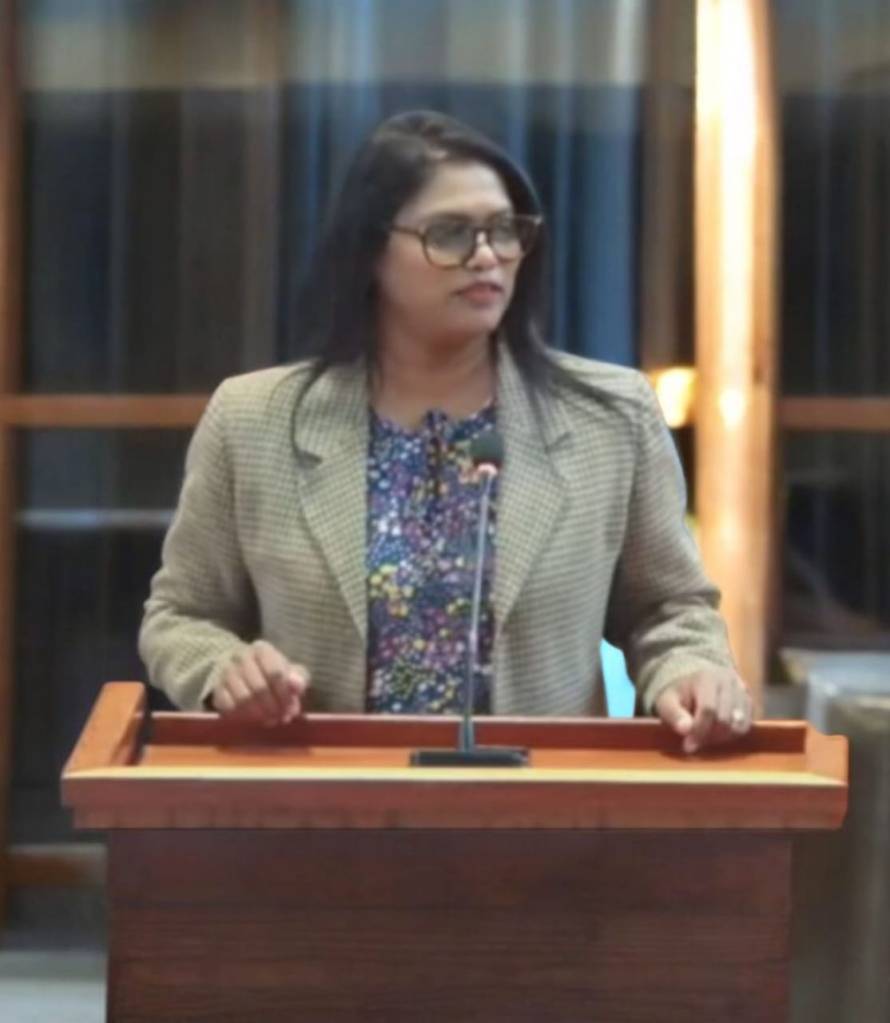
Address to the 3rd Annual Tailings and Mine Waste Conference and Workshop
9 to 11 September 2026 | Johannesburg, South Africa
By Advocate Chrystal Pillay
Chief Executive Officer of the South African Human Rights Commission
Programme Director
Leaders and representatives of civil society organisations and government institutions,
Commissioners,
Members of affected mining communities,
Traditional and community leaders,
Academics, environmental and human-rights defenders,
Distinguished guests, colleagues and fellow citizens / or ladies and gentlemen.
It is an honour to address this important gathering at a time when the question of tailings justice has become inseparable from the broader struggle for human rights, environmental justice, accountability and democratic governance.
We meet at a difficult moment—not only for communities living alongside mining operations and mine waste facilities, but also for human-rights institutions, civil society organisations and everyone committed to the constitutional promise that every person in South Africa must live with dignity, equality and freedom.
The underlying theme in my address for today is, “Human Rights Under Attack: How to Survive and Serve Individuals and Communities in Times of National and Global Societal Crisis” – A Call to Action.
This requires us to confront a difficult reality: human rights are most vulnerable precisely when people need them most.
- The Human Cost of Mine Tailings
The issue before this conference is therefore not simply a technical question about mining waste.
Behind every tailings facility are human beings.
There are families who breathe the air. There are children who attend schools near mining operations. Communities whose water sources may be affected. Farmers whose land and livelihoods depend upon environmental conditions. Workers and residents who may face health and safety risks.
When tailings facilities fail, leak, collapse or are inadequately managed, the consequences can be catastrophic.
But even where there is no dramatic disaster, a community may experience a slow and cumulative erosion of its rights through pollution, displacement, loss of land, health impacts, inadequate consultation, lack of access to information, damage to livelihoods or failures of regulatory oversight.
We must therefore reject the idea that a human-rights violation occurs only when there is a spectacular incident.
- Tailings Justice Is Human-Rights Justice
This is why the issue of tailings is so important.
Tailings are not merely an engineering or environmental-management issue.
They are a human-rights issue.
Where tailings contamination affects water, the right to access sufficient water is implicated.
Where pollution affects health, the right to an environment that is not harmful to health or well-being becomes relevant.
Where communities are displaced, land, housing, livelihood and dignity issues arise.
Where people are excluded from decisions that affect their lives, participation and administrative-justice concerns arise.
Where the government fails to monitor or enforce the law, the issue becomes one of State accountability.
The Commission’s earlier work on mining-affected communities found significant challenges relating to land, housing, water and the environment, as well as weaknesses in consultation, access to information, compliance, monitoring and enforcement. (SAHRC)
More recently, the Commission has continued to investigate mining-related human-rights concerns at provincial level and has used its statutory powers where government departments fail to cooperate with investigations. In 2018 the Commission compiled a report on tailings disasters with recommendations for implementation; it further participated in symposiums held on the Jagersfontein collapse and is continuing interventions insofar as compensation for those who suffered substantial losses as a result of that occurrence. In 2025, the Commission issued a subpoena to a senior official in the Department of Mineral Resources concerning an investigation into alleged mining-related harms in Mooinooi.
And now we are trying to intervene in the sludge surge issue in Brits insofar as allegations against Samancor and other role players are concerned.
These are not abstract institutional exercises.
They concern people.
- Human Rights Institutions Under Pressure
Across the world, democratic institutions are experiencing increasing pressure. Human-rights defenders are being threatened, public institutions are being challenged, civic space is narrowing in some environments, and communities demanding accountability are sometimes portrayed as obstacles to development.
South Africa is not immune to these pressures.
The South African Human Rights Commission exists because our Constitution recognises that rights cannot be protected merely by writing them into a document. They require institutions that can investigate violations, monitor compliance, receive complaints, conduct inquiries, engage organs of state, make recommendations and, where necessary, approach the courts.
But institutions established to hold power accountable will inevitably experience resistance.
The Commission itself has, at various times, faced criticism, public attacks and attempts to undermine confidence in its work. We must acknowledge this reality without becoming paralysed by it.
An independent human-rights institution cannot measure the legitimacy of its work by whether those whose conduct it scrutinises are pleased with its findings.
Our measure must be the Constitution, the law, the evidence we rely on and the lived experiences of the people whose rights we are mandated to protect.
Where the Commission is wrong, it must be held accountable. Where its processes can be improved, they must be improved. But criticism must never become a substitute for evidence, nor must attacks on an institution become a means for avoiding accountability.
How then do we protect and advance human rights when human-rights institutions themselves are under pressure, communities are facing profound social and environmental crises, and the institutions of the State are struggling to respond?
The question is not theoretical.
It is being asked every day by communities living next to mines, tailings storage facilities, abandoned mine shafts and polluted water sources.
It is being asked by families who fear for their children’s health.
It is being asked by communities whose land, livelihoods and access to water are affected by mining activities.
And it is being asked by the South African Human Rights Commission as we confront an increasingly complex human-rights environment with limited resources.
Our answer must be clear:
A crisis of resources should not become a crisis of constitutional ambition.
But neither can we continue with the notion that an institution with a nationwide mandate can continue indefinitely to operate through traditional methods when the scale and complexity of human-rights challenges are growing faster than its resources.
- Human Rights Are Most Vulnerable When Society Is in Crisis
We are living through a period of profound global and national uncertainty.
War, displacement, climate change, economic inequality, unemployment, food insecurity, political polarisation, technological disruption, misinformation and declining trust in public institutions are placing extraordinary pressure on democratic societies.
South Africa has its own deep structural challenges.
Poverty and inequality remain pervasive.
Many communities experience inadequate access to water, housing, healthcare, education and safe environments.
There are communities living with the consequences of historic and continuing environmental degradation.
And there is growing frustration with the ability of institutions to translate constitutional promises into lived realities.
This is precisely the environment in which human-rights institutions become indispensable.
The SAHRC’s constitutional mandate is to promote respect for human rights and a culture of human rights, promote the protection, development and attainment of human rights, and monitor and assess the observance of human rights in South Africa. (SAHRC)
But the Commission does not itself provide water.
It does not build hospitals.
It does not operate mines.
It does not issue mining licences.
It does not police communities.
It does not replace government departments or regulators.
Its role is different.
We investigate. We monitor. We engage. We make findings. We recommend remedies. We advocate. And where necessary, we use the law and the courts to secure redress.
That distinction is fundamental to understanding both the power and the limitations of a National Human Rights Institution.
- The Reality: The SAHRC Cannot Do Everything
Let us be frank about something that we do not discuss often enough.
The Commission has a very large constitutional mandate and limited resources.
For the 2025/26 financial year, the Commission experienced budget constraints as did other organs of state.
The Commission itself warned that any budget reduction would have a negative impact on its work. (SAHRC)
The Commission has fewer than 200 employees spread across the country and a shrinking budget to cover its responsibilities and expenses. (SAHRC)
Yet the demand for our services is enormous.
During 2025/26, the Commission reported a high number of finalised complaints and an increase in monitoring a number of facilities across the country. You will take note that our numbers for finalisation have decreased due to an amended indicator and target.
This is an extraordinary workload for an institution of our size.
And the demand is not declining. It is becoming more complicated.
Human-rights violations increasingly involve multiple institutions, overlapping mandates, scientific evidence, environmental questions, socio-economic rights, administrative failures and corporate conduct.
A single community complaint about a tailings facility may involve:
Various regulatory frameworks such as mining legislation; environmental legislation; water regulation; municipal governance; occupational health and safety; public health; disaster management; corporate accountability; and constitutional rights, and the list can go on.
No single institution can adequately resolve all of that.
(Our Provincial Offices alone are made up of between 10 to 12 members.)
We therefore need to do two things simultaneously:
defend the independence and integrity of the Commission, and fundamentally change the way in which we work.
- The Commission Has Decided It Is Imperative to Change the Way We Work: From an Institution That Responds to an Institution That Is Proactive
One of the most important changes we have made is to move from being predominantly reactive to becoming increasingly proactive.
To do this, we strengthen partnerships.
With civil society organisations, who are often the first to identify emerging problems.
Communities, often the first to see changes in water, dust, air quality, land stability and health.
Environmental organisations to provide scientific expertise. Government organisations and stakeholders to understand the regulatory framework.
The Commission can bring these sources of knowledge together and determine where there is evidence of systemic human-rights risk.
- But How Does the SAHRC Do More With Less?
This brings us directly to the question of capacity and budget.
On an annual basis we continue to make the case for adequate funding. (NT)
A constitutional institution should not be expected to perform an expanding mandate indefinitely with declining resources.
Adequate funding is not a privilege for the Commission. It is an investment in constitutional democracy.
But we also acknowledge that if/when we receive additional resources we cannot simply do more of the same—rather we would work differently.
And of course, we take the decision to work differently to a model in which the Commission becomes a strategic convenor, investigator, knowledge centre and an accountability mechanism.
This means five changes.
First: Prioritisation
Identifying matters where the Commission can have the greatest systemic impact. A single well-designed investigation into systemic failures affecting twenty communities may achieve more than treating twenty communities as twenty unrelated complaints.
Second: Partnerships
We leverage the expertise and reach of civil society.
Where an organisation already has scientific expertise, community networks or legal capacity, the Commission attempts not to duplicate that work but rather to collaborate.
Third: Data Gathering and Databases
Promoting enhanced human-rights intelligence.
Assessing complaints, monitoring information, accessing community reports, environmental information and analysing government responses all together to identify patterns.
Fourth: Strategic Litigation
We use litigation selectively so as not to litigate every dispute but to establish important principles, secure remedies and clarify the law where systemic human-rights protection requires it.
Where legal avenues are available, civil society and the Commission explore strategic litigation and other appropriate remedies.
The objective is not litigation for its own sake.
The objective is an effective remedy.
Fifth: Follow-Through
We have become and are taking further steps to enhance our systematic approach to monitoring whether the government implements our findings and recommendations.
A report cannot be the end of an investigation.
It must be the beginning of an accountability process.
As you will know, the Commission does not have enforcement powers.
Therefore recommendations must be taken seriously. Where appropriate, matters should be referred to competent authorities, regulators, Parliament, provincial structures or the courts.
- The Importance of the Constitutional Court’s Clarification
This is particularly important following the Constitutional Court’s judgment in early 2026 in the Agrodata v the SAHRC which clarified the Commission’s powers concerning its directives.
The Court clarified that, after concluding an investigation, the Commission may issue directives concerning appropriate redress. Where a respondent refuses to act, the Commission or complainant may approach a court for appropriate relief. The Court however did state that as a constitutional institution—ISD—it is not toothless.
This is important for communities. First because it means it must approach the courts to have its directives implemented.
It means that the Commission’s finding that a violation occurred and its directive on appropriate redress is not binding and if one is not satisfied it can be taken on judicial review.
Gives rise to the question:
What happens if the responsible institution (corporate or government) refuses to act?
The answer must be a structured pathway from:
complaint → investigation → finding → directive/recommendation → implementation → monitoring → enforcement through litigation where necessary. This requires adequate funding—because of the rise in litigation costs—both for the Commission and in the public interest.
This is the accountability chain.
But there is another challenge that we must confront honestly.
Attacks on the credibility and integrity of the Commission which result in having to take steps to defend the independence of the Commission.
Which is another dimension to this discussion that we cannot avoid.
When human-rights institutions investigate powerful interests, they can themselves become targets.
Attacks against the Commission must therefore be understood within the broader question of how democratic societies respond to independent oversight.
We should not expect the Commission to be immune from criticism. In a constitutional democracy, criticism is legitimate and necessary.
But there is an important distinction between legitimate scrutiny and efforts to intimidate, delegitimize or disable an institution because it has performed its constitutional mandate.
But we are increasingly operating in an information environment in which allegations can travel faster than facts.
The Commission has itself had to respond to misinformation and disinformation about its work and staff. Misinformation about a large part of its staff complement comprising foreign nationals.
In September 2025, we had to publicly address allegations concerning our composition and role, noting that our staff complement was 169, of whom seven were non-nationals.
This raises a fundamental question:
How does a National Human Rights Institution (NHRI) defend its credibility without becoming defensive?
Ideally, the Commission should not become an institution that responds to criticism by attacking its critics.
That would undermine the very democratic principles we are mandated to protect.
The answer to attacks is not defensiveness.
The answer is stronger independence, greater transparency, better evidence, professional excellence and closer engagement with the public. The answer is institutional discipline.
The Commission must be willing to account for its own performance while remaining uncompromising about its mandate.
- Accountability Cannot Be Achieved by One Institution Alone
The South African Human Rights Commission cannot do this work alone.
Nor should it.
One of the lessons in periods of national and global crisis is that human-rights protection becomes stronger when institutions work together.
The Commission must therefore continue to strengthen its relationships with civil society organisations, community-based organisations, legal organisations, environmental justice movements, researchers, trade unions, universities, professional bodies and, most importantly, affected communities.
Civil society often sees problems before formal institutions do.
Community organisations know where the risks are.
Residents know which boreholes have changed, which streams are polluted, which roads are unsafe, which promises were made and which promises were broken.
Human-rights organisations may have the legal and advocacy expertise to translate those experiences into claims for accountability.
Researchers may provide the scientific evidence necessary to establish causation and risk.
And constitutional institutions can use their investigative and legal powers to bring these strands together.
- Civil Society and the Commission: A Compact for Accountability
I therefore propose that we deepen what might already be described as a Human Rights Accountability Ecosystem between the Commission, civil society and affected communities.
Imagine what becomes possible when the Commission, community organisations, environmental justice organisations, universities, legal clinics, public-interest lawyers, investigative journalists, scientists, health professionals and affected communities work in complementary ways.
The community identifies the problem.
Civil society documents it.
Scientists establish the environmental or health evidence.
Lawyers identify the legal implications.
The Commission investigates systemic human-rights dimensions.
Government is required to respond.
Parliamentary and public oversight mechanisms are activated.
Courts are approached where necessary.
And communities monitor whether remedies are actually implemented.
That is much more powerful than any one organisation working alone.
- Surviving Crisis Without Losing Our Purpose
How human-rights institutions survive in times of crisis.
My answer is that survival cannot be our only objective.
We must survive in order to serve.
We survive by maintaining institutional integrity, by investing in capable people, by protecting evidence and institutional memory.
We survive by building partnerships rather than operating in isolation.
We survive by listening to criticism without surrendering our independence.
And we survive by remembering why institutions such as the South African Human Rights Commission exist in the first place as an institution established in terms of Chapter 9 of the Constitution to support democracy.
They exist because ordinary people often do not have the same power, resources or access as governments, corporations and other powerful actors.
The purpose of a human-rights institution is therefore not simply to produce reports.
It is to help ensure that power is exercised within the limits of the Constitution and the law.
- The Constitutional Responsibility of Government
At the heart of tailings justice is a fundamental principle:
The government has a constitutional responsibility to protect people from human-rights violations, including those arising from environmental harm and failures of regulation.
This responsibility cannot simply be delegated to mining companies.
Companies have responsibilities. Operators must comply with the law, maintain safe facilities, prevent environmental harm and respect affected communities.
But the State has a different and indispensable responsibility.
Government must establish appropriate laws and standards. It must conduct effective monitoring.
It must ensure that licences and authorisations are properly administered. It must investigate credible complaints. It must enforce the law. It must ensure that affected communities have access to information and effective remedies.
Where government agencies know—or reasonably ought to know—that people are exposed to serious risks and fail to take reasonable steps to protect them, the question of State accountability arises.
That is why tailings justice is also a governance issue.
It is about whether the institutions of the State are functioning as they should.
- The SAHRC Makes a Call to Government
I also wish to use this platform to make a direct appeal to the government.
Where communities raise credible concerns about tailings facilities and environmental harm, the government must listen.
Where there is evidence of risk, government must act.
Where regulations are breached, enforcement must follow.
Where government agencies fail to perform their duties, there must be accountability.
And where people suffer harm as a consequence of failures in governance, they must have access to meaningful remedies.
The answer cannot always be another meeting, another referral or another report.
At some point, accountability must become visible in action.
- The SAHRC Makes a Call to Civil Society
To civil society, I say: continue to challenge us.
Continue to bring evidence.
Continue to organise communities.
Continue to use the law.
Continue to expose systemic failures.
But let us also build mechanisms for constructive engagement with constitutional institutions.
The Commission should be a partner in the struggle for human rights, not merely an institution to approach after everything else has failed.
Let us develop relationships that allow concerns to be escalated early, evidence to be shared lawfully and responsibly, and systemic issues to be identified before they become disasters.
- Conclusion
Ladies and gentlemen,
Tailings justice ultimately asks us a much larger question:
What kind of society do we want to be?
Do we want a society in which economic activity takes place at any cost?
Or do we want a society in which economic development is governed by constitutional values, environmental responsibility, human dignity and accountability?
The Constitution gives us the answer.
It places human dignity, equality, freedom and accountability at the centre of our democratic project.
The task before us is to make those principles real for people living in communities affected by mining and mine waste.
The South African Human Rights Commission will continue to play its constitutional role.
But we will be stronger when we work with civil society.
We will be more effective when communities are at the centre.
We will be more credible when our conclusions are grounded in evidence.
And we will achieve greater accountability when government, business and civil society understand that human rights are not an obstacle to development—they are a condition for just, sustainable and legitimate development.
We must continue to collaborate.
And, above all, we must continue to serve the people whose rights we have been entrusted to protect.
Human rights under attack must become human rights defended.
Communities under threat must become communities empowered.
Evidence of violation must become accountability.
And accountability must ultimately become justice.
I thank you.


Leave a comment